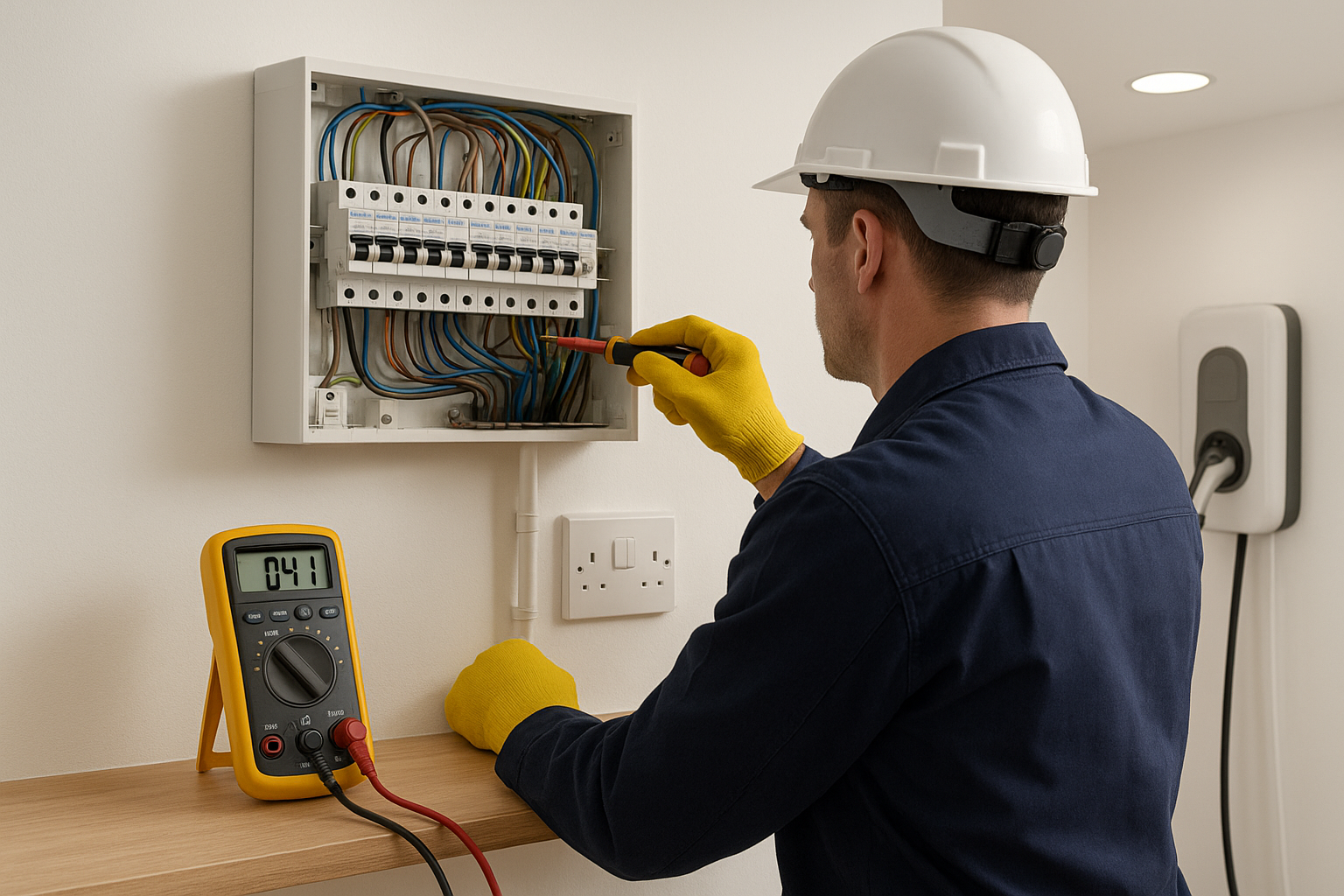
If your fuse box keeps tripping, will not reset, or is showing signs of heat, noise or burning, you need a proper fault investigation rather than a quick guess. Infinity Electric Services provides fuse box repair in Chiswick for homeowners, landlords, tenants and property managers dealing with lost power, repeated breaker trips and aging consumer units.
We work across Chiswick and nearby areas including Turnham Green, Kew, Hammersmith, Acton and Brentford, helping with domestic homes, flats, shops and offices. In many properties around Chiswick High Road, Duke Road and near Turnham Green Station, the issue is not just the fuse box itself but a fault on a circuit, a damaged accessory, moisture ingress, an overloaded socket run or an older consumer unit that needs checking carefully.
Our approach is process-led: enquiry, inspection, testing, repair, certification where required, and practical advice so you understand what has failed and what should happen next. If you need help with a fuse box fault, call 020 3633 2514 or email info@chiswick-electricians.co.uk.
We are based at 2 Cedars Rd, Chiswick, London W4 3EJ, UK and operate 24 hours.
Fuse Box Fault Finding in Chiswick
Fuse box fault finding is the starting point when you have no clear answer for why power is being lost. The consumer unit may be doing its job by disconnecting a dangerous circuit, but the underlying cause still needs tracing. That is especially common in Chiswick properties where older wiring has been altered over time, such as Victorian terraces, converted flats, older rewires and mixed-age installations with additions made by different trades.
Common signs include a fuse box that keeps tripping, a breaker that will not reset, a buzzing or hot fuse board, or half the house having no power. We also investigate situations where a single room, socket circuit or lighting circuit is affected, because the fault may be local to one piece of equipment rather than the whole board.
During a fault-finding visit, we first listen to the symptoms and ask when the issue happens. For example, does the trip occur when a kettle, heater, washing machine or oven is used? Does it happen after rain? Has there been recent decorating, drilling, a socket change or a new appliance? These details help narrow down whether the problem is overload, a damaged cable, a failing accessory, a loose connection or a defective device.
We then inspect the consumer unit and relevant circuits, checking for obvious signs of wear, heat damage, contamination, loose terminations or signs that an older fuse wire board may be past safe service. Where needed, we isolate the affected circuit, trace the issue and explain the repair options in plain English. If a repair is possible, we will say so. If the consumer unit is too old or too compromised, we will explain why a replacement or upgrade may be the safer route.
For properties near Chiswick House and Gardens, Gunnersbury Park and the surrounding residential streets, this careful approach is often the difference between a short-term reset and a proper fix. We do not recommend switching circuits back on repeatedly if a fault is still present, because that can worsen damage or create a safety risk. If you notice burning smells, heat, smoke, sparking or repeated trip events, switch off where safe and arrange an electrician promptly.
Tripping Breaker Investigation in Chiswick
A tripping breaker investigation is needed when the breaker or MCB keeps disconnecting and you cannot tell whether the issue is the breaker, the circuit, or the equipment plugged into it. This is a common call-out in homes and small businesses across Chiswick, especially where multiple appliances share one circuit or where older installations have been adapted over the years.
We begin by identifying which breaker is operating and what it feeds. That may be sockets, lighting, a kitchen appliance, an immersion heater or a dedicated circuit for a larger item of equipment. Once the affected circuit is identified, we test methodically rather than replacing parts at random.
Typical causes include:
- Overloaded socket circuits
- Faulty appliances or extension leads
- Loose or damaged connections
- Insulation faults in cables
- Moisture affecting outdoor, kitchen or bathroom circuits
- Age-related wear in the consumer unit or breaker
In a recent consumer unit fault check in Kew, we investigated a tripping circuit, checked the consumer unit and isolated the affected circuit before giving clear repair advice. In a Turnham Green flat, we visited a property where circuits were tripping and explained consumer unit repair or upgrade options in plain language. That kind of visit is typical of the work we carry out: trace, isolate, test, explain.
If the breaker is doing exactly what it should because the circuit has a fault, replacing the breaker alone will not solve the problem. If the breaker itself is worn or defective, a replacement may be appropriate after testing confirms that the circuit is otherwise sound. We only recommend replacing equipment when the evidence points that way.
For tenants and landlords, a tripping breaker can quickly become disruptive, especially if it affects heating, cooking or refrigeration. We can help identify whether the issue is likely to be within the installation or caused by an appliance or accessory, and we can advise on the next safe step. If the fault is on a circuit serving a rented property, it may also need recording and certification depending on the work completed.
RCD Nuisance Tripping in Chiswick
RCD nuisance tripping in Chiswick is a frequent concern in homes with modern protective devices, particularly where there are appliances with small leakage currents, damp conditions, or older wiring that does not behave well with newer equipment. An RCD may trip because it has detected a real fault, but it may also be reacting to a combination of load, moisture, age or deterioration that needs investigation.
We look at the pattern of the tripping first. Does it happen at certain times of day, when a particular appliance starts, after rain, or when several items are used together? Does the RCD trip immediately, or only after some time? These clues help separate a genuine circuit fault from a nuisance trip caused by equipment or installation conditions.
Our inspection may involve checking the consumer unit, testing the affected circuit, isolating appliances, and looking for signs of damp around outdoor fittings, garden equipment, kitchens, bathrooms or utility areas. In Chiswick, where homes can range from older converted flats to modern apartments and mixed-use premises, the layout and age of the wiring often matter as much as the device itself.
It is important not to keep resetting an RCD repeatedly without understanding why it has operated. If it is tripping because of an earth fault, damaged cable or failing appliance, continued resetting can mask the problem and leave the circuit unsafe. We will explain whether the issue can be resolved by repair, equipment replacement or a wider circuit review.
Where an RCD is found to be unsuitable, worn or not functioning correctly, we can advise on the next steps. If the issue is caused by a circuit with a genuine fault, we will identify the likely source and recommend the repair needed. In some cases, the best outcome is not a quick reset but a proper safety check and a targeted repair plan.
Faulty Breaker Replacement in Chiswick
Faulty breaker replacement in Chiswick is only considered after the installation has been inspected and tested. A breaker can fail mechanically, become worn, or show signs of damage after repeated fault events. However, a breaker is also a protective device, so replacing it without checking the circuit can leave the underlying fault unresolved.
We assess whether the breaker has failed, whether it has been operating because of a real circuit issue, or whether the problem lies elsewhere in the consumer unit or installation. If replacement is appropriate, we match the device to the circuit requirements and check that the wiring, loading and protective arrangement remain suitable.
This is particularly relevant in older homes around Duke Road, Chiswick High Road and the streets off Turnham Green, where installations may have been altered over time. It is also common in shops and offices where added equipment, lighting changes or small power upgrades have changed the load on the system.
We do not advise changing breakers as a guess. A breaker that keeps tripping may be protecting you from a fault, and the real issue could be a damaged socket, a failing appliance, or a circuit fault hidden in a wall or ceiling. Where a replacement is needed, we will explain why, carry out the work carefully and test the circuit afterwards so the result is verified.
If the consumer unit is older and several devices are showing signs of wear, we may recommend discussing consumer unit work rather than replacing only one part. That can be a more practical long-term option where safety, reliability and future maintenance are all being considered.
Fuse Board Safety Checks in Chiswick
Fuse board safety checks in Chiswick are useful whenever you are unsure whether the consumer unit is in safe condition, especially in older properties or after repeated faults. A safety check is not the same as a cosmetic inspection. It is a practical review of the board, its condition and the circuits it protects.
We look for signs such as heat damage, corrosion, loose or disturbed terminations, outdated protective devices, poor circuit labelling, signs of overloading and any visible issues that suggest the installation needs closer attention. In homes with older fuse wire boards, we will also assess whether the board remains fit for purpose or whether replacement should be discussed.
For landlords and property managers, this is particularly important when a tenant reports repeated trips, a dead circuit or a buzzing board. A proper check helps establish whether the problem is urgent, whether the fault is localised, and whether further testing or remedial work is needed before the property is handed back into normal use.
We also consider the wider context of the property. A converted flat may have shared service routes, older alterations or limited access to certain runs. A modern flat may have more recent protective devices but still suffer from appliance faults or overloaded circuits. A shop or office may have additional lighting or equipment that changes the demand on the board. The right check depends on the installation in front of us, not on assumptions.
Where work is carried out that requires certification, we will advise accordingly. Some electrical work is notifiable under Part P of the Building Regulations, and customers should always ask for the relevant certification for completed work. If you are comparing options, ask for current scheme registration and insurance details before booking electrical work.
Our recent work in the area includes a socket replacement visit in Hammersmith, where we replaced damaged socket fronts and tested the circuit so the customer could use the outlets safely again. That same careful testing mindset applies to fuse box repair: fix the fault, then confirm the circuit behaves as expected.
If you need fuse box repair in Chiswick, or you are dealing with fuse box fault finding, tripping breaker investigation, RCD nuisance tripping, faulty breaker replacement or fuse board safety checks, Infinity Electric Services is ready to help. We provide clear advice, practical testing and repair-focused support for homes and businesses across Chiswick and nearby locations including Turnham Green, Kew, Hammersmith, Acton and Brentford.
Call 020 3633 2514 or request a visit today.
Infinity Electric Services
2 Cedars Rd, Chiswick, London W4 3EJ, UK
Phone: 020 3633 2514
Email: info@chiswick-electricians.co.uk